Thinking With Hip-Hop
What A.D. Carson’s Being Dope taught me about knowledge, democracy, and why universities still don’t know what to do with rap

For the better part of the last decade, I have found myself making the same argument in different rooms.
Sometimes I’m standing in front of undergraduates trying to convince them that hip-hop deserves to be taken seriously as a form of civic expression. Other times I’m speaking to faculty colleagues who still see rap as an engaging teaching tool but hesitate to recognize it as a legitimate source of theory. Occasionally, I’m talking with journalists or media professionals who are perfectly comfortable celebrating hip-hop’s commercial success but become noticeably quieter when the conversation shifts toward its intellectual contributions.
The argument changes depending on the audience, but the underlying tension remains remarkably consistent. Hip-hop is welcomed as culture long before it is welcomed as knowledge.
That tension has followed me throughout my academic career. It shaped my dissertation. It shaped Hip-Hop Civics. It shapes the courses I teach on race, media and digital culture. More recently, it has shaped my thinking about what I call the clout economy, particularly the ways Black cultural production generates forms of value that institutions eagerly monetize but remain reluctant to recognize as intellectual labor.
I found myself thinking about all of this while reading A.D. Carson’s Being Dope.
Calling Being Dope a book about hip-hop feels technically correct but intellectually insufficient. Carson is certainly writing about rap music, Black language, race, academia and American culture. But somewhere along the way, the book quietly shifts its center of gravity. Hip-hop stops functioning as the object being analyzed and becomes the method through which analysis happens. Carson is not simply asking readers to appreciate rap. He is asking us to think with it.
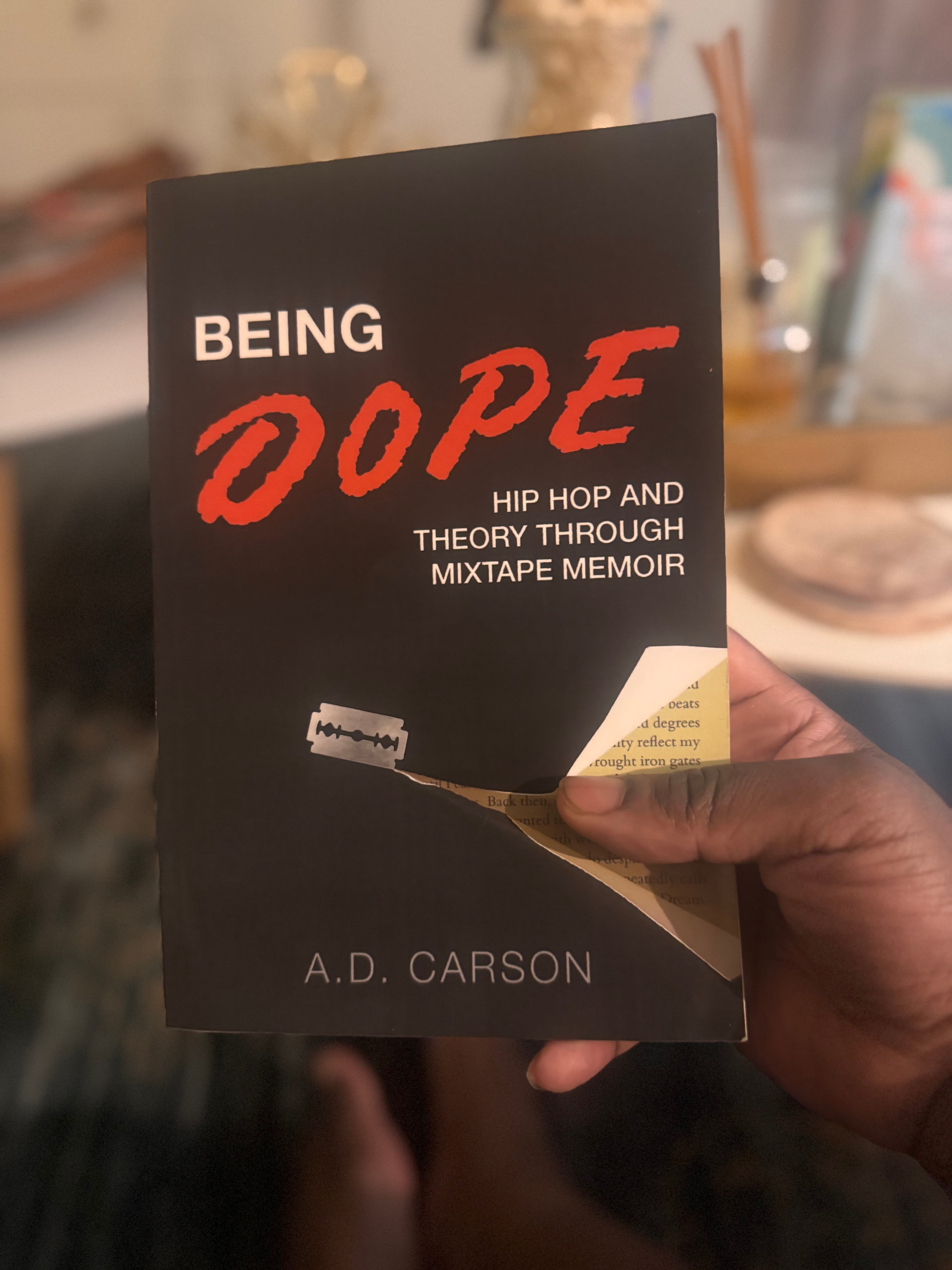
That distinction may seem small, but I suspect it explains why I found the book so generative.
One of my favorite moments arrives almost immediately. Carson opens by describing Being Dope as “a bad book,” almost daring readers to question what qualifies as good scholarship in the first place. At first glance, the statement reads like self-deprecation. By the time I reached the end of the book, however, I realized it was something else entirely. It was an act of refusal. Carson was declining the invitation to perform academic legitimacy on terms that universities have historically reserved for forms of knowledge coded as white, elite and respectable.
That opening immediately reminded me of one of the central tensions in my own work.
For years, I have argued that hip-hop belongs in universities. Carson pushed me toward a more uncomfortable question: what if universities also need to become a little more hip-hop?
The difference matters. The first argument asks institutions to make room for a new object of study. The second asks institutions to reconsider how knowledge itself is produced, circulated and legitimized. One is about inclusion. The other is about transformation.
Reading Being Dope, I began to realize that Carson is less interested in convincing readers that hip-hop deserves respect than he is in demonstrating that hip-hop has already developed sophisticated ways of knowing the world. Long before universities decided rap was worthy of scholarly attention, artists, DJs, producers, journalists, poets and community organizers were theorizing democracy, race, capitalism, language, memory and public life through hip-hop’s own intellectual traditions.
That realization stayed with me long after I closed the book. It also made me think differently about the direction of my own scholarship. Increasingly, I find myself less interested in arguing that hip-hop should be admitted into academic conversations and more interested in asking what those conversations become once hip-hop is allowed to shape them.
That, to me, is the deeper invitation of Being Dope. Carson is not asking us to become fans of rap music. He is asking us to recognize that hip-hop has been producing theory all along.
Meaning Is Not the Only Thing That Matters
One of the most provocative moves in Being Dope comes when Carson compares Chief Keef’s reshaping of rap music to Christopher Rufo’s reshaping of public discourse around critical race theory. The comparison is not an argument that the two figures are morally or politically equivalent. Rather, Carson is interested in how both demonstrate the power of signification, repetition and affect. Their influence does not depend entirely on the precision of what they say. It depends on the energy their words create, the reactions they provoke and the ability of that reaction to invite others into a larger cultural performance.
Rufo’s intervention into debates about critical race theory succeeded in part because it was never primarily concerned with offering an accurate account of the field. He transformed a complex body of legal and intellectual scholarship into a flexible political symbol that could absorb nearly any institutional grievance involving race, education or diversity. The term became effective because of what it made people feel. It generated fear, resentment, defensiveness and a sense of ideological emergency. The definition mattered less than the circulation of the phrase and the public energy organized around it.
Carson sees something structurally similar in the rise of Chief Keef and drill music. Keef’s influence cannot be adequately explained by parsing his lyrics as though they were conventional political statements or transparent sociological reports. His music created an atmosphere. It produced a sonic and visual energy that other artists, audiences and media makers wanted to inhabit, reproduce and elaborate. The deeper cultural question is therefore not simply what Chief Keef meant, but what his work made possible.
That distinction matters to me because I have made a related argument in my own scholarship. Chief Keef’s technological genius as a content creator may be one of his most significant contributions to hip-hop. He did not simply make music that represented a local Chicago experience. He helped transform a local feeling into an interconnected system of songs, videos, social media posts, gestures, slang and visual performances that could travel far beyond the neighborhoods from which they emerged. The music mattered, but so did the ecology around it.
Carson pushes this argument one step further. On page 210, he suggests that scholars might spend their time more productively by studying artists like Keef with less concern for what every individual word means. He asks, “How can we argue with a feeling?” The question is intentionally disruptive because academic criticism has often treated interpretation as the highest form of understanding. We are trained to decode the text, clarify the argument and locate the stable meaning beneath the surface. Hip-hop frequently refuses that stability.
This does not mean that lyrics are meaningless or that scholars should stop evaluating the political and ethical implications of cultural expression. It means that semantic interpretation is only one part of the task. Music also acts upon bodies. It produces motion, anxiety, desire, identification, fear, pleasure and collective response. A song may reorganize public feeling even when its lyrics are repetitive, fragmented or resistant to conventional forms of profundity.
Media scholars sometimes describe this as affect, the bodily and emotional force a cultural object produces before, alongside or beyond conscious interpretation. Carson’s reading of Keef reminded me that hip-hop scholars have sometimes been more comfortable treating rap as literature than as atmosphere. Literary analysis gives us valuable tools, but it can also tempt us to believe that the most important work occurs inside the words. Sometimes the cultural force of a song resides in the texture of the voice, the repetition of a phrase, the distortion of the bass or the feeling that emerges when a group of people recognizes the record at the same moment.
I have been thinking about this recently while writing about Yung Miami’s “Spend Dat.” Much of the criticism surrounding the song has focused on whether its lyrics reproduce familiar stereotypes about Black women, money and sexuality. Those questions are legitimate. The song draws upon recognizable archetypes and exists within a commercial culture that often reduces Black women to narrow scripts. But focusing on the lyrics alone misses how the song actually circulates. Its hook moves through TikTok videos, clubs, strip clubs, podcasts, memes, playlists and group chats. For many listeners, the cultural text is not the entire song. It is a repeated phrase, a beat, a joke and a shared mood.
Carson’s work helps me articulate why that distinction matters. Cultural significance is not always produced through argumentative depth. Sometimes it is produced through stickiness. Sometimes a song matters because it gives people a language for a feeling they already possess. Sometimes it reorganizes the room before anyone has decided whether its message is politically responsible.
This is not an excuse to suspend criticism. It is an invitation to practice a fuller form of criticism. We should be capable of examining what a cultural object represents while also accounting for what it does. We can ask whether a song reproduces harmful stereotypes and still study why people find it pleasurable. We can criticize a public figure’s rhetoric while also examining the emotional infrastructure that makes the rhetoric effective. We can distinguish between the ethical value of an idea and the communicative power of its delivery.
That distinction is especially important in digital culture. Contemporary media systems are increasingly organized around circulation rather than reflection. A phrase does not need to be accurate to become influential. It needs to be repeatable. A performance does not need to be profound to become culturally consequential. It needs to generate response. Meaning remains important, but it now competes with metrics of reaction, replication and recognizability.
This is also where Carson’s argument intersects with my interest in hip-hop as a resource for civic imagination. If artists such as Chief Keef can generate powerful forms of identification and collective energy, the educational question is not simply how to condemn or celebrate that energy. It is how to understand its architecture. What conditions allow a local expression to become a global language? How does a particular sound make young people feel recognized? How might educators and community organizers generate comparable forms of excitement, participation and belonging without attempting to imitate the music superficially?
Carson is not asking scholars to become uncritical fans of Chief Keef. He is asking us to notice that critique becomes incomplete when it only argues with content and ignores feeling. A civic educator cannot merely offer young people better information and expect that information to move them. Facts matter, but participation also requires energy, identification, rhythm and a sense that something is at stake.
Hip-hop has always understood this. The cipher, the battle, the block party and the live performance are not only vessels for transmitting ideas. They create environments in which people experience themselves as part of something. They turn spectators into participants. They make knowledge social and embodied.
That may be one of the most important lessons I took from Carson’s discussion of Chief Keef. The question is not whether feeling should replace meaning. It is whether scholarship has mistaken meaning for the entirety of culture. Hip-hop reminds us that ideas do not circulate through argument alone. They move through sound, repetition, performance, pleasure, provocation and the difficult-to-measure energy that tells us something is dope before we have fully explained why.
Whiteness, Illicitness and the Work of Rapwashing
Carson’s insistence that it is “nearly impossible to have a responsible conversation about hip-hop and not discuss race” feels obvious until one considers how often institutions attempt to do exactly that. Hip-hop is routinely discussed through sales, influence, innovation, controversy and celebrity while the racial conditions that made the culture necessary are treated as secondary context. Yet hip-hop’s histories of creativity, criminalization, appropriation and commodification cannot be separated from Black life in the United States. Race is not an optional interpretive layer placed over the music after the fact. It is embedded in the conditions of its production and in the uneven ways artists are received.
This is especially clear when Carson turns to white participation in rap. The commercial success of artists such as Vanilla Ice and Eminem did not simply prove that white artists could rap. Their careers revealed how the industry could rearrange the meaning of whiteness in order to make it profitable within a Black cultural form. Loren Kajikawa has written that Eminem and his collaborators had to transform how whiteness functioned in hip-hop by emphasizing its contradictions. Eminem was presented not as someone benefiting from racial privilege, but as the ultimate underdog: poor, angry, culturally marginalized and embattled by respectable society.
That framing allowed him to inhabit the outsider position central to rap authenticity while remaining legible to a vast white consumer market. His early Slim Shady persona also anticipated the logic of contemporary outrage culture. Provocation was not incidental to his appeal. It was central to the product. The vulgarity, misogyny, violence and hostility generated condemnation, but condemnation expanded the audience. Public outrage became a distribution strategy long before platforms offered dashboards showing how anger could be converted into impressions.
Eminem was not the first white rapper to benefit from this dynamic. Carson’s discussion of Vanilla Ice is useful because it exposes how selectively moral scrutiny has been applied. Vanilla Ice’s debut became one of the fastest-selling rap albums of its era despite displaying many of the qualities critics claimed made hip-hop socially dangerous: vulgarity, self-aggrandizement, manufactured street credibility and a commercially engineered vernacular. Yet his legacy has rarely carried the same burden of explaining rap’s supposed corruption of American youth.
That discrepancy matters. Black artists have routinely been treated as evidence against their communities, while white artists are more often treated as individuals, curiosities or commercial anomalies. When Black rappers perform aggression, misogyny or violence, those performances are read as symptoms of Black cultural dysfunction. When white artists perform similar material, the performance is more likely to be read as provocation, rebellion, satire or entrepreneurial theater.
Carson’s analysis suggests that the rap industry developed an assembly-line capacity to manufacture recognizable signs of authenticity: vernacular speech, self-aggrandizement, criminal proximity, hypermasculinity and street credibility. Once those signs became profitable, they could be detached from Black communities and reproduced through artists whose whiteness gave the industry access to larger audiences and different forms of cultural forgiveness. The industry did not have to abandon Blackness. It could extract a portable version of it.
This is one reason my work on the clout economy cannot treat hip-hop simply as an origin story for contemporary attention-seeking. The history of clout is also a history of appropriation and cultural gentrification. Black expressive practices generate forms of visibility, credibility and social energy that are later detached from their communities, reformatted for wider consumption and redistributed through institutions that often retain the profits. Black identity becomes extraordinarily valuable as mediated performance while Black people remain structurally vulnerable.
Carson’s notion of “dopeness” provides another way to understand this contradiction. He argues that dope is not defined solely by the substance itself. It is also produced through the circumstances that make the substance possible and the context through which it becomes illicit. As he writes, whatever is prescribed and collected from the pharmacy is not necessarily “dope,” even when it is chemically a drug. The distinction lies partly in the door through which the substance enters and the gatekeepers who determine its legitimacy.
The same principle applies to culture. What becomes dangerous, vulgar, innovative or respectable often depends on who is producing it and through which institutions it circulates. Rap can be condemned as musically ghetto when Black artists insist upon its unruly qualities, then celebrated as artistic innovation once those same qualities have been translated into elite institutional spaces. Carson calls the attempt to make the illicit legal by redefining it in more acceptable terms a form of narrative violence. Something is taken from the conditions that gave it potency and then presented as legitimate only after those conditions have been stripped away.
Tyler, the Creator’s response to winning the Grammy for Best Rap Album in 2020 is instructive here. He described the recognition as a backhanded compliment because “rap” had become the category into which Black artists were placed even when their work exceeded the genre boundaries imposed upon them. The designation could function less as praise than as containment. It preserved an institutional border between what the Recording Academy recognized as universal pop innovation and what it coded as musically Black.
Carson argues that rappers’ relationship with the Recording Academy mirrors America’s broader antagonistic relationship with Black people. Institutions celebrate Black cultural contributions late, selectively and often in self-congratulatory ways. The recognition allows the institution to appear progressive without requiring it to account for decades of exclusion, misrecognition and extraction. The ceremony becomes a form of absolution. The gatekeeper congratulates itself for opening a gate it built.
This institutional maneuver connects to what Carson calls rapwashing, the use of rap, rappers or hip-hop culture to conceal anti-Blackness or to redirect responsibility for American dysfunction onto Black expressive culture. His example of commentary comparing Donald Trump to a rapper illustrates the mechanism. Trump’s bragging, vulgarity, misogyny and disregard for conventional respectability were interpreted through the figure of the rapper, as though those qualities originated in hip-hop rather than in longstanding American traditions of masculine domination, racial capitalism and spectacular self-promotion.
Rapwashing allows the country to describe its own values as foreign once Black culture makes them visible. Violence becomes a rap problem. Misogyny becomes a rap problem. Materialism becomes a rap problem. Narcissism becomes a rap problem. Yet each of these tendencies has deep roots in American political, economic and social life. As Carson argues, anything deviant that can be observed in rappers can also be learned by living in the United States and absorbing its dominant values. Violence is not hip-hop’s invention. It is one of America’s most durable civic traditions.
The murder of Jordan Davis offers a devastating example of how rapwashing operates beyond metaphor. Davis was killed after a confrontation over loud music, but the cultural coding of that music helped position Black youth as threatening before any individual action could be considered. “Rap” became a shorthand for danger, aggression and disposability. The music was not merely sound. It became evidence within a racial narrative that had already decided whose fear mattered and whose life did not.
This is why Carson’s insistence on race is not a demand that every conversation about hip-hop become a predictable seminar on representation. It is a warning against analytical convenience. When hip-hop is praised without attention to race, its innovations can be appropriated as universal culture. When it is condemned, its failures can be returned to Black communities as evidence of pathology. Blackness is erased at the moment of celebration and exaggerated at the moment of blame.
A responsible conversation about hip-hop therefore requires more than adding racial context to an otherwise complete analysis. It requires examining how race determines what becomes legible as art, deviance, commerce, expertise and cultural value in the first place. Carson’s work reminds us that the question is not simply whether something is dope. We must also ask who is permitted to name it, who is rewarded for circulating it, and what happens to its meaning once it passes through the gate.
Being Dope as an Academic Method
Carson’s most consequential invitation may be his insistence that readers do more than study hip-hop. Near the end of Being Dope, he explains that his goal is not to produce more hip-hop fans, but to encourage more people to think about and, more importantly, think with hip-hop. That distinction reframes the intellectual purpose of the book. Fandom can produce knowledge, but admiration alone is not analysis. Likewise, scholarship can generate insight while still holding its subjects at a clinical distance. Carson is interested in what becomes possible when those postures are unsettled and hip-hop is treated not simply as evidence to interpret, but as a mode of intellectual inquiry.
This requires separating fandom from study without pretending the two can ever be completely detached. Carson argues that such separation can give us the pause necessary to encounter rappers as people rather than merely as creators of objects that entertain, inspire or appall us. I find that point especially important because hip-hop scholarship has often defended the culture by canonizing its most legibly profound figures. Scholars have sometimes responded to rap’s marginalization by emphasizing artists whose complexity can be translated into familiar academic terms: poets, philosophers, political theorists and urban ethnographers who happen to rap. That strategy has been useful, but it can also produce another hierarchy. It implies that hip-hop deserves respect when its practitioners sound sufficiently like the people and texts the university already respects.
Carson refuses that rescue mission. He does not ask us to prove that every rapper is secretly a philosopher or that every lyric contains a hidden political treatise waiting for an enterprising professor to excavate it. Instead, he asks what the university might learn from hip-hop’s vulgarity, excess, ambiguity, repetition, play and refusal. This is a more difficult proposition because it denies scholars the comfort of believing that our primary contribution is to make hip-hop respectable. Respectability is one of the gates Carson wants us to examine.
His discussion of dopeness helps explain why. As Carson puts it, dope is not defined only by the substance being evaluated. It is also shaped by the conditions that produced it, the context through which it circulates and the institutions authorized to determine its legitimacy. A substance collected from a pharmacy may be a drug without being “dope.” The distinction depends on the door through which it enters, the gate it passes through and the social meanings attached to its movement. Dopeness, then, is not merely an aesthetic quality residing inside an object. It is relational. It emerges from history, community, risk, recognition and sometimes illicitness.
That formulation has significant implications for the study of hip-hop. Universities have become increasingly willing to admit rap into their curricula, conferences, archives and public programming. But admission often comes with translation. The culture is redescribed in terms that make it more recognizable to institutional gatekeepers. Its rough edges are softened. Its contradictions are resolved. Its illicitness is converted into innovation, resilience, entrepreneurship or diversity. Hip-hop becomes acceptable because the institution has found a way to explain it without being disrupted by it.
Carson warns that attempts to make the illicit legal by redefining it in more acceptable terms can become a form of narrative violence. Something important is lost when institutions celebrate a cultural form only after detaching it from the conditions that gave it potency. A cipher becomes an engagement exercise. Sampling becomes multimedia composition. Battle rap becomes rhetorical training. Each translation may be accurate, but the cumulative effect can resemble cultural dry cleaning. Hip-hop enters the university freshly pressed, deodorized and no longer likely to disturb the furniture.
I recognize this tension in my own academic career. Much of my work has involved arguing that hip-hop belongs in conversations about media, education, democracy and civic life. I still believe that. But Being Dope pushed me to consider whether the argument for inclusion has become too comfortable. Once hip-hop is included, what is it permitted to change? Is it allowed to challenge the conventions of scholarly writing, classroom authority and legitimate expertise, or is it simply added to the syllabus while the institution continues operating according to the same values?
Carson’s own career illustrates the problem. He notes that his academic accomplishments are often described as successes achieved despite rap music’s supposedly banal, appalling or ghetto qualities. That language reproduces a familiar American story of individual overcoming. The scholar becomes impressive because he escaped, transcended or disciplined the culture from which his work emerged. Hip-hop becomes an obstacle conquered on the way toward academic legitimacy rather than the intellectual tradition that made the scholarship possible.
I have encountered variations of that logic myself. Hip-hop is welcomed when it helps engage students, diversify a reading list or make an institutional event feel culturally current. It becomes more threatening when it challenges how expertise is defined, who controls the classroom or what counts as a scholarly contribution. The university appreciates hip-hop’s ability to attract attention but remains less certain about surrendering authority to its methods. It wants the playlist without necessarily wanting the politics of the DJ booth.
Thinking with hip-hop would require something more substantial. It would mean recognizing improvisation as intellectual labor, call-and-response as a form of collective knowledge production and sampling as a method of placing texts, histories and voices into unexpected relation. It would also mean acknowledging that argument can operate through rhythm, tone, repetition, humor and feeling rather than through exposition alone. None of this eliminates the need for evidence or rigor. It expands the forms through which rigor can be expressed.
This is where Carson’s discussion of Chief Keef returns as a pedagogical challenge. If Keef’s music generated an energy powerful enough to reorganize rap’s sonic and visual language, then educators should be interested in the conditions that produced that response. The point is not to imitate drill music in the classroom or to treat cultural relevance as a costume educators can put on before class. Young people can detect that sort of cosplay with supernatural efficiency. The deeper task is to understand how belonging, recognition, repetition, local knowledge and creative autonomy generate participation.
That question is central to my own interest in using local hip-hop cultures to cultivate civic imagination among young people. Civic education often assumes that participation will follow once students receive accurate information about institutions. Information is necessary, but it is rarely sufficient. People also need to feel that public life concerns them, that their language matters and that their presence can alter the outcome. Hip-hop has long known how to produce that feeling. It creates environments in which knowledge becomes embodied, social and consequential.
This may be what Carson means when he invites us to think with hip-hop. He is not proposing a new collection of examples for scholars to analyze. He is asking whether hip-hop’s ways of making, questioning and relating might change the intellectual processes through which scholarship occurs. That possibility is both exciting and unsettling because it would require universities to relinquish some control over the gates through which knowledge passes.
Carson begins Being Dope by announcing that it is a bad book and suggesting that perhaps this is the best it can be. In that spirit, this may be a bad book review. I have not attempted to evaluate every chapter, adjudicate every claim or determine whether Carson successfully follows the conventions of academic argument. I am also not particularly interested in resolving whether his refusal of those conventions occasionally becomes its own kind of performance. The point is that I am here, still thinking with the book after finishing it.
That may be the most useful measure of its dopeness. The book generated questions that exceeded its pages. It forced me to reconsider my own assumptions about meaning, feeling, expertise, legitimacy and the work hip-hop can perform inside educational institutions. It reminded me that the value of scholarship is not exhausted by its conclusions. Sometimes scholarship matters because of the intellectual energy it releases and the possibilities that energy allows others to imagine.
For years, I have worked to demonstrate that hip-hop deserves a place within the university. After reading Carson, I find myself less interested in winning that argument. Hip-hop is already present. It is taught, archived, cited, exhibited and celebrated across higher education. The more difficult question is whether the university is willing to be changed by its presence.
Hip-hop does not need the academy to certify that it is dope. The academy may need hip-hop to remember that knowledge should do more than preserve its own authority. It should move people, disturb settled categories, create new relationships and make better questions possible.